Bowen disease
Bowen disease are squamous cell carcinomas (SCC) of the epidermis that are in situ. As opposed to a classical SSC, the term Bowen disease is used for a SCC that only exists throughout the entire epidermis and intraepidermal portion of adnexal structures, with no invasion into the dermis. In a classical SCC, there is invasion into the dermis. They may arise de-novo or from pre-existing Actinic Keratoses. Lesions are typically solitary.
Etiology
The etiology of BD is multifactorial. Risk factors are similar to Actinic Keratoses. Cumulative exposure to UV light produces DNA damage which facilitates the clonal expansion of underlying p53 mutation.
However, unlike AKs, HPV- and arsenic-related SSC in situs are possible. HPV 16 is associated with BD, especially vulvar and penile BD. Erythroplasia of Queyrat (EQ), also known as SCC in-situ of the penis, has risk factors such as uncircumcised penis, phimosis, poor hygiene, chronic inflammation, smoking, and PUVA therapy. HPV 8,16,39 and 51 has been isolated from lesions of EQ. 6% of lichen sclerosus of the penis is known to develop EQ.
Epidemiology
BDs is more common in males than females, and the incidence increases with age.
Pathophysiology
Histopathology
Keratinocyte atypia is seen throughout the entire epidermis and has the potential to progress to invasive SCC, with an estimated risk of ~3-~5% if untreated.
Presentation and history
Clinically presents as an erythematous patch or thin plaque with scale - occasionally, the lesions are pigmented.
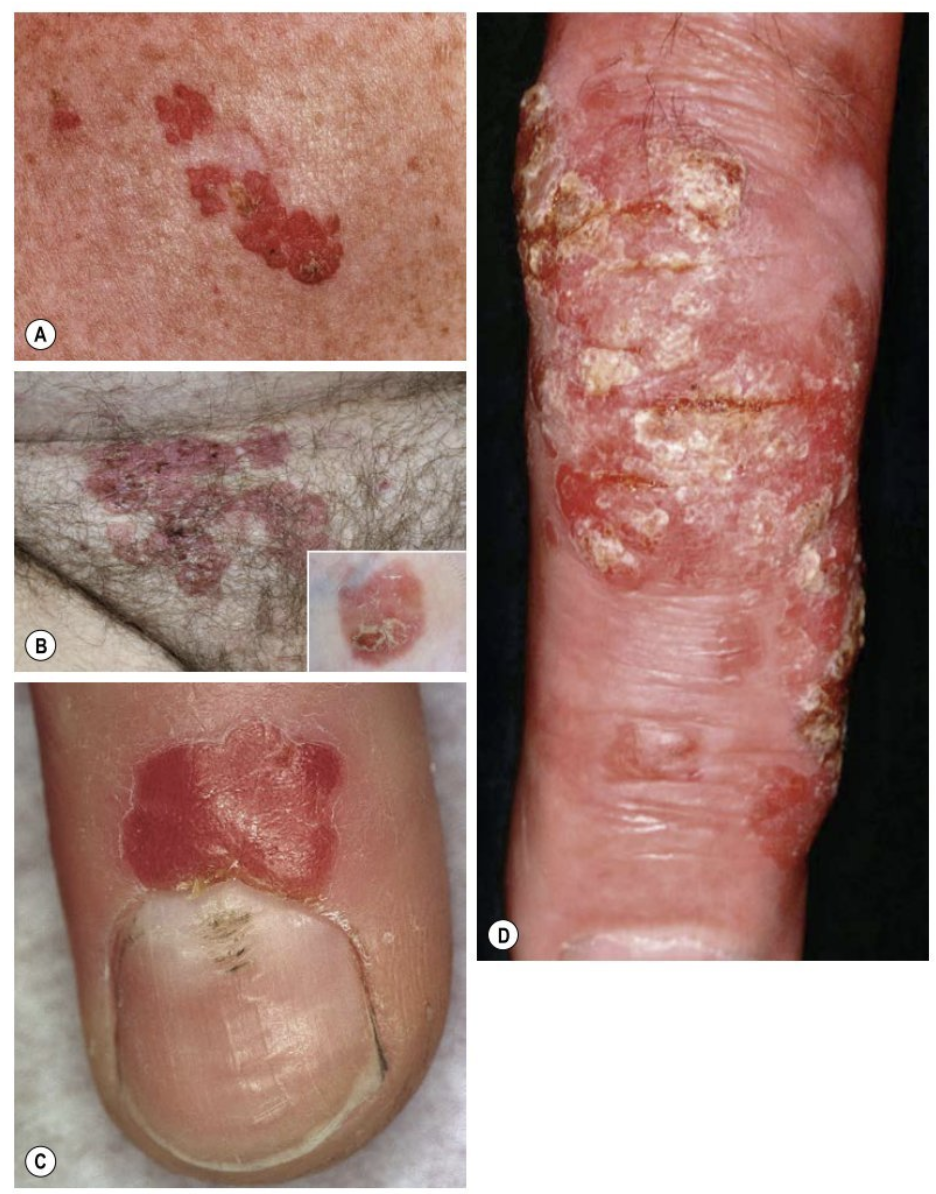
There may occasionally be nail involvement of BDs, which may eventually destroy
the nail plate. It will initially result in a red streak known as erythronychia.
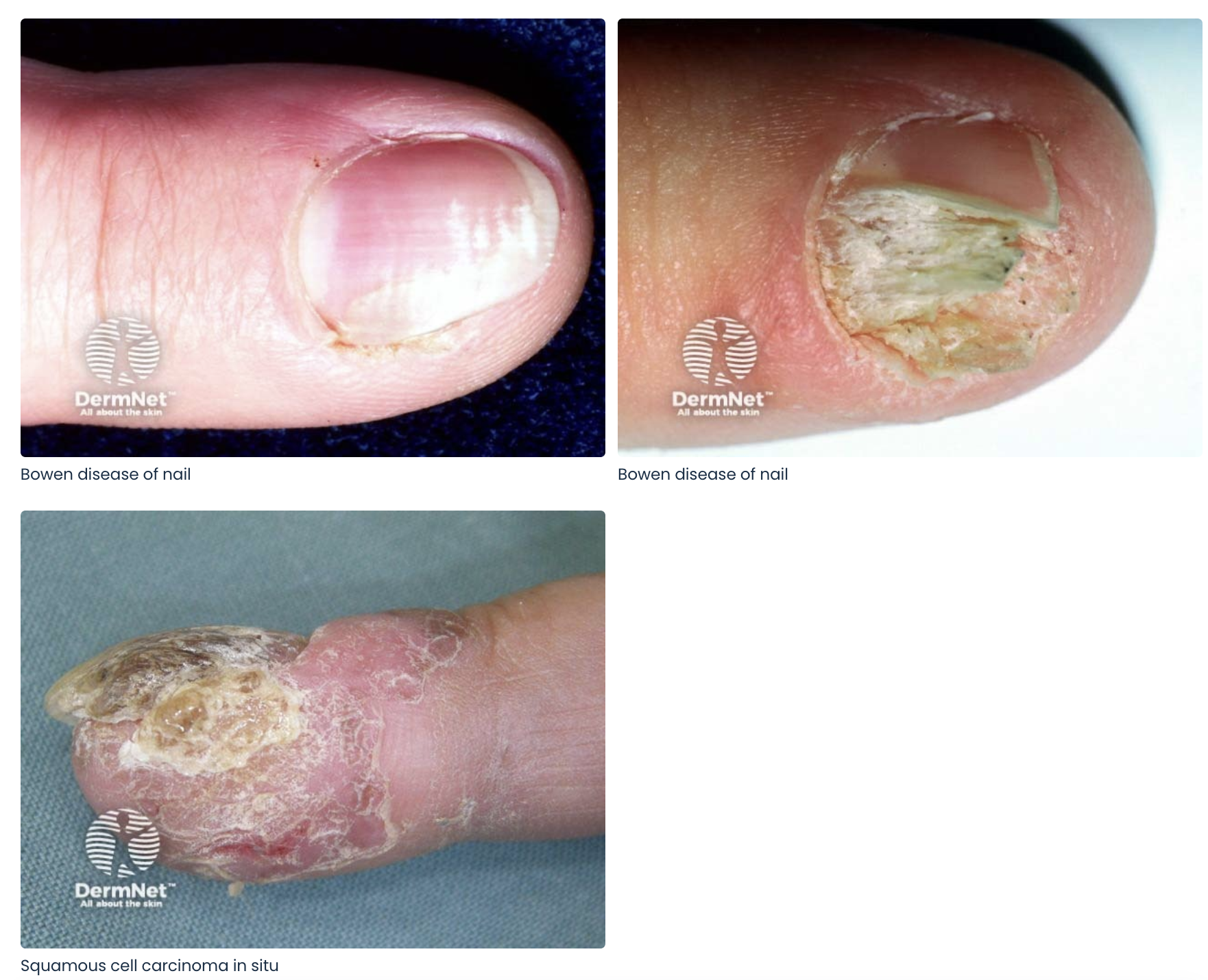
Common sites are ones that are chronically sun exposed. Less common sites include beard area, periungual (nail), and subungual, anogenital (now referred to as intraepithelial neoplasia, further qualified by anatomic site). SSC in situ in non-sun exposed sites may also be related to arsenic exposure.
Investigations and diagnosis
A biopsy is needed and a dermoscopy may assist in diagnosis.
Management and treatment
A tangential excision with curettage OR electrodesiccation and curettage (especially for smaller lesions), excision, Mohs micropahic surgery (head and neck, acrogenital). Imiquimod cream and topical 5% fluorouracil (twice daily for a longer period; 8 weeks) may be used when a surgical approach would prove difficult to perform because of location or extent.
Prognosis
SCC in-situ has the potential to progress to invasive SCC, with an estimated risk of ~3-~5% if untreated.
Differential diagnosis
Invasive SCC
BCC
Benign lichenoid keratosis
Irritated seborrheic keratosis
Amelanotic melanoma
BDs may occasionally be misdiagnosed as an isolated lesion of psoriasis or nummular eczema, but a clue is its lack of response to appropriate therapy