Pupillary light reflex and RAPDs
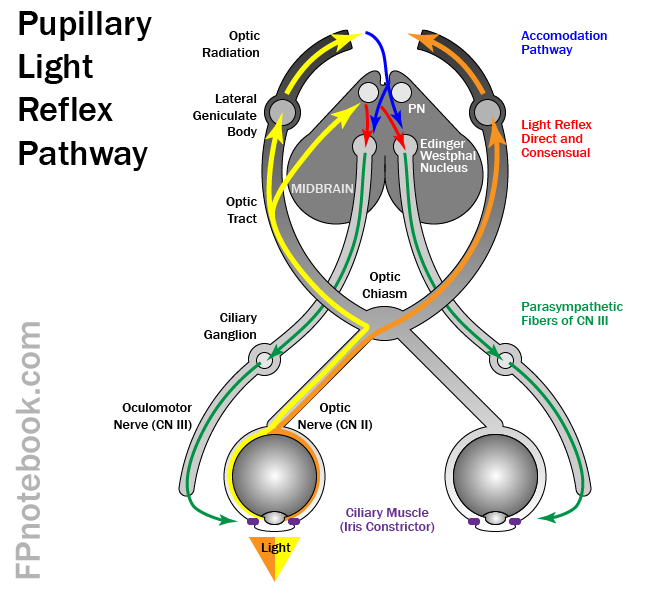
Light moves into the eye, eventually reaching the optic nerve (CN II). At the optic chiasm, nasal retinal fibres cross to the contralateral side of the optic tract, and the temporal retinal fibrers continue on the ipsilateral side.
The optic tract joins the brachium of the superior colliculus, and then signals travel to the pretectal area of the midbrain. Each pretectal area sends bilateral signals to the preganglionic parasympathetic nuceli in the midbrain called Edinger-Westphal nuceli. There are a minority of axons that go to the hypothalamus and the olivary pretectal nucleus (OPN). Efferent parasympathetic preganglionic fibres travel on the oculomotor nerve and synapse with the ciliary ganglion, which sends postganglicolic axons to directly innervate the iris sphincter muscle.
The afferent limb is the nerve fibres that run with the optic nerve CN II. Each pupillary light pathway has two efferent limbs. The two efferent limbs are ipsilateral and contralateral. At the level of the pretectal area, a signal is sent to both Edinger-Westphal nucelus, on the ipsilateral and contralateral side. This means that when the light is shined in one eye, the other will constrict, unless there is a RAPD. It is also known as a Marcus Gunn pupil.
In a RAPD, the pupil will excessively dilate when the light is swung from the unaffected eye to the affected eye. The affected eye will still sense